Tuesday, May 12, 2015

War Threat Rises As Economy Declines, Warns Paul Craig Roberts

Keynote Address to the Annual Conference of the Financial West Group, New Orleans, May 7, 2015
The defining events of our time are the collapse of the Soviet Union, 9/11, jobs offshoring, and financial deregulation. In these events we find the basis of our foreign policy problems and our economic problems.
The United States has always had a good opinion of itself, but with the Soviet collapse self-satisfaction reached new heights. We became the exceptional people, the indispensable people, the country chosen by history to exercise hegemony over the world. This neoconservative doctrine releases the US government from constraints of international law and allows Washington to use coercion against sovereign states in order to remake the world in its own image.
To protect Washington’s unique Uni-power status that resulted from the Soviet collapse, Paul Wolfowitz in 1992 penned what is known as the Wolfowitz Doctrine. This doctrine is the basis for Washington’s foreign policy. The doctrine states:
“Our first objective is to prevent the re-emergence of a new rival, either on the territory of the former Soviet Union or elsewhere, that poses a threat on the order of that posed formerly by the Soviet Union. This is a dominant consideration underlying the new regional defense strategy and requires that we endeavor to prevent any hostile power from dominating a region whose resources would, under consolidated control, be sufficient to generate global power.”
In March of this year the Council on Foreign Relations extended this doctrine to China.
Washington is now committed to blocking the rise of two large nuclear-armed countries. This commitment is the reason for the crisis that Washington has created in Ukraine and for its use as anti-Russian propaganda. China is now confronted with the Pivot to Asia and the construction of new US naval and air bases to ensure Washington’s control of the South China Sea, now defined as an area of American National Interests.
9/11 served to launch the neoconservatives’ war for hegemony in the Middle East. 9/11 also served to launch the domestic police state. While civil liberties have shriveled at home, the US has been at war for almost the entirety of the 21st century, wars that have cost us, according to Joseph Stiglitz and Linda Bilmes, at least $6 trillion dollars. These wars have gone very badly. They have destabilized governments in an important energy producing area. And the wars have vastly multiplied the “terrorists,” the quelling of which was the official reason for the wars.
Just as the Soviet collapse unleashed US hegemony, it gave rise to jobs offshoring. The Soviet collapse convinced China and India to open their massive underutilized labor markets to US capital. US corporations, with any reluctant ones pushed by large retailers and Wall Street’s threat of financing takeovers, moved manufacturing, industrial, and tradable professional service jobs, such as software engineering, abroad.
This decimated the American middle class and removed ladders of upward mobility. US GDP and tax base moved with the jobs to China and India. US real median family incomes ceased to grow and declined. Without income growth to drive the economy, Alan Greenspan resorted to an expansion of consumer debt, which has run its course. Currently there is nothing to drive the economy.
When the goods and services produced by offshored jobs are brought to the US to be sold, they enter as imports, thus worsening the trade balance. Foreigners use their trade surpluses to acquire US bonds, equities, companies, and real estate. Consequently, interests, dividends, capital gains, and rents are redirected from Americans to foreigners. This worsens the current account deficit.
In order to protect the dollar’s exchange value in the face of large current account deficits and money creation in support of the balance sheets of “banks too big to fail,” Washington has the Japanese and European central banks printing money hand over fist. The printing of yen and euros offsets the printing of dollars and thus protects the dollar’s exchange value.
The Glass-Steagall Act that separated commercial and investment banking had been somewhat eroded prior to the total repeal during the second term of the Clinton regime. This repeal, together with the failure to regulate over the counter derivatives, the removal of position limits on speculators, and the enormous financial concentration that resulted from the dead letter status of anti-trust laws, produced not free market utopia but a serious and ongoing financial crisis. The liquidity issued in behalf of this crisis has resulted in stock and bond market bubbles.
Implications, consequences, solutions:
When Russia blocked the Obama regime’s planned invasion of Syria and intended bombing of Iran, the neoconservatives realized that while they had been preoccupied with their wars in the Middle East and Africa for a decade, Putin had restored the Russian economy and military.
The first objective of the Wolfowitz doctrine–to prevent the re-emergence of a new rival–had been breached. Here was Russia telling the US “No.” The British Parliament joined in by vetoing UK participation in a US invasion of Syria. The Uni-Power status was shaken.
This redirected the attention of the neoconservatives from the Middle East to Russia. Over the previous decade Washington had invested $5 billion in financing up-and-coming politicians in Ukraine and non-governmental organizations that could be sent into the streets in protests.
When the president of Ukraine did a cost-benefit analysis of the proposed association of Ukraine with the EU, he saw that it didn’t pay and rejected it. At that point Washington called the NGOs into the streets. The neo-nazis added the violence and the government unprepared for violence collapsed.
Victoria Nuland and Geoffrey Pyatt chose the new Ukrainian government and established a vassal regime in Ukraine.
Washington hoped to use the coup to evict Russia from its Black Sea naval base, Russia’s only warm water port. However, Crimea, for centuries a part of Russia, elected to return to Russia. Washington was frustrated, but recovered from disappointment and described Crimean self-determination as Russian invasion and annexation. Washington used this propaganda to break up Europe’s economic and political relationships with Russia by pressuring Europe into sanctions against Russia.
The sanctions have had adverse impacts on Europe.Additionally, Europeans are concerned with Washington’s growing belligerence. Europe has nothing to gain from conflict with Russia and fears being pushed into war. There are indications that some European governments are considering a foreign policy independent of Washington’s.
The virulent anti-Russian propaganda and demonization of Putin has destroyed Russian confidence in the West. With the NATO commander Breedlove demanding more money, more troops, more bases on Russia’s borders, the situation is dangerous. In a direct military challenge to Moscow, Washington is seeking to incorporate both Ukraine and Georgia, two former Russian provinces, into NATO.
On the economic scene the dollar as reserve currency is a problem for the entire world. Sanctions and other forms of American financial imperialism are causing countries, including very large ones, to leave the dollar payments system. As foreign trade is increasingly conducted without recourse to the US dollar, the demand for dollars drops, but the supply has been greatly expanded as a result of Quantitative Easing. Because of offshored production and US dependence on imports, a drop in the dollar’s exchange value would result in domestic inflation, further lowering US living standards and threatening the rigged, stock, bond, and precious metal markets.
The real reason for Quantitative Easing is to support the banks’ balance sheets. However, the official reason is to stimulate the economy and sustain economic recovery. The only sign of recovery is real GDP which shows up as positive only because the deflator is understated.
The evidence is clear that there has been no economic recovery. With the first quarter GDP negative and the second quarter likely to be negative as well, the second-leg of the long downturn could begin this summer.
Moreover, the current high unemployment (23 percent) is different from previous unemployment. In the postwar 20th century, the Federal Reserve dealt with inflation by cooling down the economy. Sales would decline, inventories would build up, and layoffs would occur. As unemployment rose, the Fed would reverse course and workers would be called back to their jobs. Today the jobs are no longer there. They have been moved offshore. The factories are gone. There are no jobs to which to call workers back.
To restore the economy requires that offshoring be reversed and the jobs brought back to the US. This could be done by changing the way corporations are taxed. The tax rate on corporate profit could be determined by the geographic location at which corporations add value to the products that they market in the US. If the goods and services are produced offshore, the tax rate would be high. If the goods and services are produced domestically, the tax rate could be low. The tax rates could be set to offset the lower costs of producing abroad.
Considering the lobbying power of transnational corporations and Wall Street, this is an unlikely reform. My conclusion is that the US economy will continue its decline.
On the foreign policy front, the hubris and arrogance of America’s self-image as the “exceptional, indispensable” country with hegemonic rights over other countries means that the world is primed for war. Neither Russia nor China will accept the vassalage status accepted by the UK, Germany, France and the rest of Europe, Canada, Japan and Australia. The Wolfowitz Doctrine makes it clear that the price of world peace is the world’s acceptance of Washington’s hegemony.
Therefore, unless the dollar and with it US power collapses or Europe finds the courage to break with Washington and to pursue an independent foreign policy, saying good-bye to NATO, nuclear war is our likely future.
Washington’s aggression and blatant propaganda have convinced Russia and China that Washington intends war, and this realization has drawn the two countries into a strategic alliance. Russia’s May 9 Victory Day celebration of the defeat of Hitler is a historical turning point. Western governments boycotted the celebration, and the Chinese were there in their place. For the first time Chinese soldiers marched in the parade with Russian soldiers, and the president of China sat next to the president of Russia.

The Saker’s report on the Moscow celebration is interesting
. Especially note the chart of World War II casualties. Russian casualties compared to the combined casualties of the US, UK, and France make it completely clear that it was Russia that defeated Hitler. In the Orwellian West, the latest rewriting of history leaves out of the story the Red Army’s destruction of the Wehrmacht. In line with the rewritten history, Obama’s remarks on the 70th anniversary of Germany’s surrender mentioned only US forces. In contrast Putin expressed gratitude to “the peoples of Great Britain, France and the United States of America for their contribution to the victory.”
For many years now the President of Russia has made the point publicly that the West does not listen to Russia. Washington and its vassal states in Europe, Canada, Australia, and Japan do not hear when Russia says “don’t push us this hard, we are not
your enemy. We want to be your partners.”
As the years have passed without Washington hearing,Russia and China have finally realized that their choice is vassalage or war. Had there been any intelligent, qualified people in the National Security Council, the State Department, or the Pentagon, Washington would have been warned away from the neocon policy of sowing distrust. But with only neocon hubris present in the government, Washington made the mistake that could be fateful for humanity.

Japanese Govt Bonds Are Crashing After Weakest Auction Since Lehman

Today's 10Y JGB auction saw the lowest bid-to-cover ratio since Feb 2009 at just 2.24x with a notable tailof 1.1bps (the widest since March) as it appears once again, the total dissolution of liquidity from the largest bond market in the world has left the BoJ and Ministry of Finance losing control. The reaction is dramatic with 5Y through 30Y yields up 5-8bps (10Y +8bps at 47.6bps - the biggest absolute jump in yields in 2 years)leaving 30Y yields at 2-month highs above 1.49% and 10Y yields at 6-month highs.
Weakest auction since Feb 2009...

Repricing the entire curve dramatically higher...

Sending 10Y yields crashing the most in 2 years to 6-month highs...

This is a major problem, since as we discussed previously,the reignition of VaR shocks (in the 'safest' of assets) can quickly lead to forced selling to reduce risk allocations...
The second self-feeding dynamic is something we’ve discussed at lengthbefore, most notably in 2013 when volatility-induced selling — reminiscent of the 2003 JGB experience — hit the Japanese bond market again, prompting us to ask the following rhetorical question:

What happens to JGB holdings as the benchmark Japanese government bond continues trading with the volatility of a 1999 pennystock, and as more and more VaR stops are hit, forcing even more holders to dump the paper out of purely technical considerations?

The answer was this: A 100bp interest rate shock in the JGB yield curve, would cause a loss of ¥10tr for Japan's banks.

What we described is known as a VaR shock and simply refers to what happens when a spike in volatility forces hedge funds, dealers, banks, and anyone who marks to market to quickly unwind positions as their value-at-risk exceeds pre-specified limits.

Predictably, VaR shocks offer yet another example of QE’s unintended consequences. As central bank asset purchases depress volatility, VaR sensitive investors can take larger positions — that is, when it’s volatility times position size you’re concerned about, falling volatility means you can increase the size of your position. Of course the same central bank asset purchases that suppress volatility sow the seeds for sudden spikes by sucking liquidity from the market.
In a nutshell, this means that once someone sells, things can get very ugly, very quickly.
Charts: Bloomberg

Monday, May 11, 2015

Magnetic Reversals

Scientists tell us that our magnetic poles have reversed in the past, and that they will again. The last one occurred 780,000 years ago. The average time period between reversals is 450,000 years, but there isn’t really any pattern, it is random. We are overdue by average only.
Scientists don’t really know how the process works, and are unable to predict the next reversal. They have been telling us that the process takes hundreds or thousands of years. Recent studies have shown that it can happen in the space of weeks or months, and I suggest it can happen overnight. Perhaps rapid reversals don’t leave much evidence – perhaps rapid reversals are quite common! For example, if it was normal for a double reversal to happen quickly – where the poles return to their original position – we wouldn’t know about any historical instances.
If a reversal involves a dramatic lessening of our geomagnetic field’s strength, then basically our shields are down, and cosmic rays reaching ground-level will greatly increase. Forget about navigational problems – we could be fried.

Pigeons

Studies have shown that pigeons have receptors in their brains that are sensitive to magnetic fields, and presumably those are a reason for their great navigation skills. It is possible that many other animals also have such receptors, but they don’t utilize them as obviously. So during a reversal, the chaos in the animal world could be significant – and of course humans are animals.

Possible Triggers

Scientists have not yet worked out what causes a magnetic reversal, but recent studies of Mercury suggest that the solar wind and particles from the Sun have an effect on planetary cores. My interpretation is that a massive solar storm could be thestraw that breaks the camel’s back and trigger a reversal if the Earth is ready for one. The Electric Universe folk have also suggested that a highly-charged comet passing by could also do the trick. Or perhaps ocean currents, after being affected by climate change, are the trigger? And if climate change is caused by the Sun, then that ties in nicely with the first theory.
Another theory comes from  Rich Muller:
where “lighter components, like oxygen, sulfur, and silicon . . . rise toward the core-mantle boundary (CMB).” Accumulating like sediment on the floor of the ocean, these “fall” upward from the core onto the surface of the mantle, which is uneven like the topography of the Earth’s surface. When enough sediment collects, it tumbles like an avalanche, into the outer core, thereby cooling it.
Rare events could trigger really big avalanches at the CMB, however. When a massive asteroid or comet slammed into Earth’s surface at an oblique angle, the lower mantle would jerk sideways, shearing off whole mountains of sediment. As the sediments slide up, a downward-sinking mass of cool iron could completely disrupt large convection cells. Although variously oriented local fields within the core would remain strong, at the surface Earth’s dipole magnetic field would collapse.
And according to Gary Glatzmaier reversals are rooted in chaos theory:
The resulting three-dimensional numerical simulation of the geodynamo, run on parallel supercomputers at the Pittsburgh Supercomputing Center and the Los Alamos National Laboratory, now spans more than 300,000 years.
Our solution shows how convection in the fluid outer core is continually trying to reverse the field but that the solid inner core inhibits magnetic reversals because the field in the inner core can only change on the much longer time scale of diffusion. Only once in many attempts is a reversal successful, which is probably the reason why the times between reversals of the Earth’s field are long and randomly distributed.

Rapid Magnetic Changes

NASA loves telling is that a magnetic reversal takes thousands of years, and that we have nothing to fear. I suggest that NASA should pay more attention to scientific studies that suggest otherwise:
…a new study of ancient copper mines in southern Israel found that the strength of the magnetic field could double and then fall back down in less than 20 years. [Wired]

This lava, Bogue says, initially started to cool and then was heated again within a year as a fresh lava flow buried it. The fresh lava re-magnetized the crystals within the rock below, causing them to reorient themselves a whopping 53 degrees. At the rate the lava would have cooled, says Bogue, that would mean the magnetic field was changing direction at approximately 1 degree per week. [Wired]

Palaeomagnetic results from lava flows recording a geomagnetic polarity reversal at Steens Mountain, Oregon suggest the occurrence of brief episodes of astonishingly rapid field change ofsix degrees per day. The evidence is large, systematic variations in the direction of remanent magnetization as a function of the temperature of thermal demagnetization and of vertical position within a single flow, which are most simply explained by the hypothesis that the field was changing direction as the flow cooled. [Nature]

the spacing in time between successive flows erupted during a transition cannot be determined accurately because the errors associated with radiometric ages are typically much greater than the duration of a polarity transition. [The Magnetic Field of the Earth: Paleomagnetism, the Core, and the Deep Mantlepage 205]
The final quote suggests that we are not able to detect rapid transitions, and that estimates of durations lasting thousands of years are are a consequence of measurement limitations.

Accelerating

This is indisputable – the speed at which the magnetic north pole is moving (not necessarily in the same direction) has recently become much faster. Because this is the entirety of our studies, we don’t know what was normal prior to the 1500s…
Not only are the poles moving rapidly – the strength of our magnetic field is diminishing as well:
Rapid changes in the churning movement of Earth’s liquid outer core are weakening the magnetic field in some regions of the planet’s surface, a new study says.
“What is so surprising is that rapid, almost sudden, changes take place in the Earth’s magnetic field,” said study co-author Nils Olsen, a geophysicist at the Danish National Space Center in Copenhagen.
…The changes “may suggest the possibility of an upcoming reversal of the geomagnetic field,” said study co-author Mioara Mandea, a scientist at the German Research Centre for Geosciences in Potsdam. [National Geographic]

The Navigational Danger

Without our magnetic shield, technology will be more at risk from solar storms. The most at risk will be satellites – they are not designed to withstand solar storms in the absence of the magnetic field. So if our GPS satellites are knocked out, planes would be grounded.
Of course planes have old-school compasses as a backup, but these certainly will not be accurate during a magnetic pole shift. So even the possibility of GPS satellites failing would be enough to ground planes – otherwise they could lose navigation mid-flight.
Ships would face the same problems of course.

The Ozone Danger

It is expected that the Ozone Layer would disappear completely during a magnetic reversal (and return afterwards). See this NASA paper, Particle Events as a Possible Source of Large Ozone Loss during Magnetic Polarity Transitions.
Major solar storms during a reversal could cause ozone depletion. According toWikipedia, humans would see at least 3x more incidences of skin cancer. The effects on all living things combined is hard to predict, but could be catastrophic when everything is added together.

The Power Grid Danger

One study has nominated massive solar storms as the trigger for a magnetic reversal. Another suggests global warming is the culprit – and global warming can be caused by increased solar activity. During a reversal our shields are down, and if there is a concurrent solar storm, the situation becomes worse again. Life on Earth won’t be affected in general, and societies that don’t rely on technology will be OK as well. The most modern societies would suffer terribly if the reversal is rapid. Power grids would fail (a major solar storm can wreck them, and a magnetic reversal would be much worse). With no electricity there is no water, no sewage being pumped, no gas stations operating, no deliveries of food. Emergency services will be compromised and unable to make much of a difference. Certainly millions would die, and a billion people would face great difficulties. Only those who have sensibly prepared by storing food and water will be able to cope.

The Cosmic Ray Danger

Detailed calculations confirm that, if the Earth’s dipole field disappeared entirely (leaving the quadrupole and higher components), most of the atmosphere could be reached by high energy particles. However, the atmosphere would stop them. Instead there would be secondary radiation of 10Be or 36Cl from collisions of cosmic rays with the atmosphere. There is evidence that this occurs both during secular variation and during reversals. [Wikipedia]
Our geomagnetic field is responsible for blocking out roughly 50% of cosmic rays [Nature]… so if our “shields are down”, cosmic radiation would double. While this would lead to increased mutations, double the current rate is nothing to worry about. However, two of the possible triggers for a magnetic pole shift are a result of increases in solar activity. This could result in an increased in charged particles from the Sun reaching Earth as well. And that could spell trouble.

Source : - http://poleshift.com/magnetic-reversals

Saturday, May 9, 2015

Japan National Debt Rises To ¥1,053,357,200,000,000

What's the point of even commenting on this unambiguous Keynesian nirvana?

5
Your rating: None Average: 5 (7 votes)

Wednesday, May 6, 2015

US Economic Confidence Crashes Most Since July To Lowest Since December

US Economic Confidence Crashes Most Since July To Lowest Since December

Tyler Durden's picture


Despite record-er stock prices, weather excuses for current economic weakness, and The Fed promising that growth is here and everything will be awesome, it appears the message has not reached the US Consumer. Gallup's U.S. Economic Confidence Index plunged 9 points last week (the largest week-to-week drop since last July) to its lowest weekly score since December. The main driver was a collapse of hope as 'outlook' fell to November lows.


Americans' Ratings of Current Conditions, Economic Outlook Both Down
Gallup's Economic Confidence Index is the average of two components: Americans' ratings of current economic conditions and their views of whether the economy is improving or getting worse. The theoretical maximum of the index is +100, if all Americans say the economy is "excellent" or "good" and "getting better." The theoretical minimum is -100, if all Americans say the economy is "poor" and "getting worse."


For the week ending May 3, 24% of Americans said the economy is excellent or good while 29% said it is poor, resulting in a current conditions score of -5 -- down four points from the previous week and the lowest current conditions score since December. The economic outlook score saw a sharper drop of eight points, to -12 -- its lowest reading since November. The latest outlook score is the result of 42% of Americans saying the economy is getting better, and 54% saying it is getting worse.
The recent dip in Americans' economic confidence -- which is being dragged down largely by the lower economic outlook component -- is likely the culmination of a variety of economic factors.
Though stocks rebounded by last Friday, the previous week had been fraught with market losses in the Dow Jones industrial average and Standard & Poor's 500 market indexes. Meanwhile, the prices Americans were paying for gas increased in the latter half of April, with the U.S. Energy Information Administration reporting an increase of 17 cents per gallon over two weeks. Gallup has found that Americans' confidence in the economy is related to how much they pay at the pump. Additionally, the recent report that the nation's GDP grew a lackluster 0.2% in the first quarter -- a disappointing figure compared with previous quarterly growth -- may have dampened consumers' economic hopes.

Thursday, April 30, 2015

The Black Swan Your Broker Won’t Tell You About

The US Dollar as we know it, derives its value based on where it trades against a basket of other currencies. Some 56% of this basket is comprised of Euros. Because of this, moves in the Dollar and the Euro tend to be closely correlated.
So, when the ECB cut interest rates to negative in June 2014, capital began to flow aggressively away from the EU and into the US Dollar. This in turn kicked off a strong US Dollar rally.
Which in turn began to implode the $9 trillion global US Dollar carry trade.
Globally, the world is awash in borrowed money… most of it in US Dollars. The US Dollar carry trade is north of $9 trillion… literally than the economies of Germany and Japan COMBINED.
When you BORROW in US Dollars you are effectively SHORTING the US Dollar. So when the US Dollar rallies… you have to cover your SHORT or you blow up.
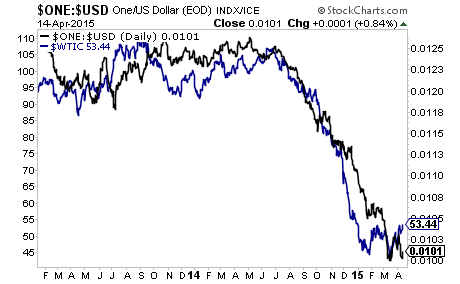
Below is a chart showing the inverse US Dollar (meaning that when the Dollar strengthens, the black line falls) and the Euro (blue line). Note that the two move almost lockstep together:
This situation is not over. The US Dollar carry trade did not clean itself out in the space of six months. Again, there are over $9 trillion in borrowed Dollars floating around the financial system. If the US Dollar continues to strengthen at a bare minimum 50% of this will need to be unwound.
If you’re looking for actionable investment strategies to profit from the coming collapse, we highly recommend you take out a trial subscription to our paid premium investment newsletter Private Wealth Advisory.
Private Wealth Advisory is a WEEKLY investment newsletter that tells you what stocks to buy, and what stocks to avoid to insure you see consistent gains. Our track record is rock solid with recent positions closed out with gains of 26%, 29%, and 37%… all held for six months.
In fact, we just closed two new winners of 20% and 52% last week!!!
And we’ve only closed ONE loser in the last 7 months!
You can try Private Wealth Advisory for 30 days (1 month) for just $0.98 cents
If you don’t like it… just drop us a line and you won’t be charged again. Everything you received during your 30 day trial (the reports, investment ideas, etc.) are yours to keep…

The Fed is Twice As Leveraged As Lehman Was


The 2008 Crisis was caused by too much debt/ leverage, particularly in the form of illiquid derivatives (mortgage backed securities get the most attention, but the derivatives market was well over $800 trillion at the time of the crisis).
To combat the financial crisis, the Fed did three things:
1)   Cut rates to zero.
2)   Abandon accounting standards.
3)   Engage in Quantitative Easing/ QE.
None of these policies represented “solutions” to the crisis. In fact, you couldn’t even accurately argue that they represented “containment.” What the Fed did was permit the very cancerous securities that nearly imploded the Wall Street banks to spread beyond from the private sector onto the public’s balance sheet.
You cannot cure cancer by letting it spread from one area of the body to the next. You cannot solve a termite problem by letting the termites move somewhere else in a house. So how could one argue that you could solve a financial crisis by letting the problems spread elsewhere in the financial system?
Consider mere leverage levels. Going into the 2008 crisis, the investment banks sported leverage levels in the 30-40s. Lehman was leveraged at 31 to 1. Morgan Stanley was leveraged at 30 to 1. Merrill Lynch peaked out in the low 40s.
Today, the Fed’s has $57.6 billion in capital and $4. 4 TRILLION in assets. That represents a leverage level of 75 to 1.
The Fed will argue that this leverage does not matter because it can print money to increase its leverage levels. This is technically true, but doesn’t alter the fact that the Fed has backed itself into a corner by buying up over $3.5 trillion worth of stuff… which the Fed has no idea how to exit.
Indeed, we know that Janet Yellen was “somewhat concerned about exit strategies”back in 2009 when the Fed’s balance sheet was $2 trillion or so. Today it’s more than TWICE that. One wonders just how “concerned” she is today, with the Fed’s balance sheet larger in size than the GDP foremost developed countries.
Even more absurd is the Fed’s ongoing issue with interest rates. Never before in history has the Fed kept rates at zero for 5+ years. But then again, never before has the Fed’s real taskmasters, the TBTFs, been sitting on over $180 trillion in interest rate based derivatives.
Those who shrug off these issues are overlooking the fact that the treasury dept. has ordered survival kits for employees at the TBTFs… while the New York Fed, has been boosting its satellite office in Chicago in preparation for potential market dislocations when the inevitable interest rate hike hits.
Indeed, nothing exposes the fallacies of the Fed’s policies of the last five years like its horror at the prospect of raising rates even a little bit. Rates have been effectively zero for five years. Today, the Fed is so concerned about what even ONE rate hike would do that it is actively preparing for potential systemic risk.
A second round of the great crisis is coming. The Fed didn’t fix 2008.; it simply set the stage for something even worse.
Smart investors are preparing now.
If you’re looking for actionable investment strategies to profit from the coming collapse, we highly recommend you take out a trial subscription to our paid premium investment newsletter Private Wealth Advisory.
Private Wealth Advisory is a WEEKLY investment newsletter that tells you what stocks to buy, and what stocks to avoid to insure you see consistent gains. Our track record is rock solid with recent positions closed out with gains of 26%, 29%, and 37%… all held for six months.
In fact, we just closed two new winners of 20% and 52% last week!!!
And we’ve only closed ONE loser in the last 7 months!
You can try Private Wealth Advisory for 30 days (1 month) for just $0.98 cents
If you don’t like it… just drop us a line and you won’t be charged again. Everything you received during your 30 day trial (the reports, investment ideas, etc.) are yours to keep…
To take out a $0.98 trial subscription to Private Wealth Advisory…

Best Regards
Graham Summers
Phoenix Capital Researc