Wednesday, June 17, 2015

The Next Great European Financial Crisis Has Begun

The Greek financial system is in the process of totally imploding, and the rest of Europe will soon follow. Neither the Greeks nor the Germans are willing to give in, and that means that there is very little chance that a debt deal is going to happen by the end of June. So that means that we will likely see a major Greek debt default and potentially even a Greek exit from the eurozone. At this point, credit default swaps on Greek debt have risen 456 percent in price since the beginning of this year, and the market has priced in a 75 percent chance that a Greek debt default will happen. Over the past month, the yield on two year Greek bonds has skyrocketed from 20 percent to more than 30 percent, and the Greek stock market has fallen by a total of 13 percent during the last three trading days alone. This is what a financial collapse looks like, and if Greece does leave the euro, we are going to see this kind of carnage happen all over Europe.European-Financial-Crisis-460x522
Officials over in Europe are now openly speaking of the need to prepare for a “state of emergency” now that negotiations have totally collapsed.  At one time, it would have been unthinkable for Greece to leave the euro, but now it appears  that this is precisely what will happen unless a miracle happens…
Greece is heading for a state of emergency and an exit from the euro following the collapse of talks to agree a bailout deal, senior EU officials warned last night.
Europe must be prepared to step in otherwise Greek society would face an unprecedented crisis with power blackouts, medicine shortages and no money to pay for police, they said.
In the past, the Greeks have always buckled under pressure.  But this new Greek government was elected with a mandate to end austerity, and so far they have shown a remarkable amount of resolve.  In order for a debt deal to happen, one side is going to have to blink, and at this point it does not look like it will be the Greeks
The world’s financial markets are facing up to the possibility that Greece could soon become the first country to crash out of Europe’s single currency. Talks between Athens and its eurozone creditors have collapsed in acrimony just days before a final deadline for Greece to unlock the €7.2bn (£5.2bn) in bailout funds it needs to avoid a catastrophic debt default.
The Greek Prime Minister, Alexis Tsipras, accused the creditor powers of hidden “political motives” in their demands that Greece make further cuts to public pension payments in return for the financial aid. “We are shouldering the dignity of our people, as well as the hopes of the people of Europe,” Mr Tsipras said in a defiant statement. “We cannot ignore this responsibility. This is not a matter of ideological stubbornness. This is about democracy.”
As we approach the point of no return, both sides are preparing for the endgame.
In Greece, members of parliament have been studying what happened in Iceland a few years ago.  Many of them believe that a Greek debt default combined with a nationalization of Greek banks and a Greek exit from the euro could set the nation back on the path to prosperity fairly rapidly.  The following comes from the Telegraph
The radical wing of Greece’s Syriza party is to table plans over coming days for an Icelandic-style default and a nationalisation of the Greek banking system, deeming it pointless to continue talks with Europe’s creditor powers.
Syriza sources say measures being drafted include capital controls and the establishment of a sovereign central bank able to stand behind a new financial system. While some form of dual currency might be possible in theory, such a structure would be incompatible with euro membership and would imply a rapid return to the drachma.
The confidential plans were circulating over the weekend and have the backing of 30 MPs from the Aristeri Platforma or ‘Left Platform’, as well as other hard-line groupings in Syriza’s spectrum. It is understood that the nationalist ANEL party in the ruling coalition is also willing to force a rupture with creditors, if need be.
Meanwhile, in a desperate attempt to get the Greeks to give in at the last moment, Greek’s creditors are preparing to pull out all the stops in order to put as much financial pressure on Greece as possible
Germany’s Suddeutsche Zeitung reported that the creditors are drawing an ultimatum to the Greeks, threatening to cut off Greek access to the European payments system and forcing capital controls on the country as soon as this weekend. The plan would lead to the temporary closure of the banks, followed by a rationing of cash withdrawals.
For a long time, most in the financial world assumed that a debt deal would eventually happen.  But now reality is setting in.  As I mentioned at the top of this article, the cost to insure Greek debt has risen by an astounding 456 percent since the beginning of this year
Given these dramatic stakes, the risk of a Greek default has gone way up. One way to measure that risk is by looking at the skyrocketing price of insurance policies that would pay out if Greek bonds go bust. The cost to insure Greek debt for one year against the risk of default has skyrocketed 456% since the start of the 2015, according to FactSet data.
These insurance-like contracts, known as credit default swaps, imply there is a 75% to 80% probability of Greece defaulting on its debt, according to Jigar Patel, a credit strategist at Barclays.
The probability of a Greek default soars to a whopping 95% for five-year CDS, Patel said.
“Default is looking more and more likely,” Peter Boockvar, chief market analyst at The Lindsey Group, wrote in a note to clients on Tuesday.
And in recent days, we have also seen Greek stocks and Greek bonds totally crash.  The following comes from CNN
The Greek stock market has plummeted 13% over the past three trading days, including a 3% drop on Tuesday alone.
In the bond market, the yield on Greek two-year debt has skyrocketed to 30.2%. A month ago, the yield was only 20%. Yields rise as bond prices fall.
Of course if there is a Greek debt default and Greece does leave the euro, it won’t just be Greece that pays the price.
As I have written about previously, there are tens of trillions of dollars in derivatives that are directly tied to currency exchange rates and 505 trillion dollarsin derivatives that are directly tied to interest rates.  A “Grexit” would cause the euro to drop like a rock and interest rates all over the continent would start to go crazy.  The financial chaos that a “Grexit” would cause should not be underestimated.
And there are signs that some of Europe’s biggest banks are already on the verge of collapse.  For example, just consider what has been going on at the biggest bank in Germany.  Both of the co-CEOs at Deutsche Bank recently resigned, and it is increasingly looking as if it could soon become Europe’s version of Lehman Brothers.  The following summary of the recent troubles at Deutsche Bank comes from an article that was posted on NotQuant
Here’s a re-cap of what’s happened at Deutsche Bank over the past 15 months: 
  • In April of 2014,  Deutsche Bank was forced to raise an additional 1.5 Billion of Tier 1 capital to support it’s capital structure.  Why?
  • 1 month later in May of 2014, the scramble for liquidity continued as DB announced the selling of 8 billion euros worth of stock – at up to a 30% discount.   Why again?  It was a move which raised eyebrows across the financial media.  The calm outward image of Deutsche Bank did not seem to reflect their rushed efforts to raise liquidity.  Something was decidedly rotten behind the curtain.
  • Fast forwarding to March of this year:   Deutsche Bank fails the banking industry’s “stress tests” and is given a stern warning to shore up it’s capital structure.
  • In April,  Deutsche Bank confirms it’s agreement to a joint settlement with the US and UK regarding the manipulation of LIBOR.   The bank is saddled with a massive $2.1 billion payment to the DOJ.  (Still, a small fraction of their winnings from the crime). 
  • In May,  one of Deutsche Bank’s CEOs, Anshu Jain is given an enormous amount of new authority by the board of directors.  We guess that this is a “crisis move”.  In times of crisis the power of the executive is often increased.
  • June 5:  Greece misses it’s payment to the IMF.   The risk of default across all of it’s debt is now considered acute.   This has massive implications for Deutsche Bank.
  • June 6/7:  (A Saturday/Sunday, and immediately following Greece’s missed payment to the IMF) Deutsche Bank’s two CEO’s announce their surprise departure from the company.  (Just one month after Jain is given his new expanded powers).   Anshu Jain will step down first at the end of June.  Jürgen Fitschen will step down next May.
  • June 9: S&P lowers the rating of Deutsche Bank to BBB+  Just three notches above “junk”.  (Incidentally,  BBB+ is even lower than Lehman’s downgrade – which preceded it’s collapse by just 3 months)
And that’s where we are now.  How bad is it?  We don’t know because we won’t be permitted to know.  But these are not the moves of a healthy company.
For a very long time, I have been warning that a major financial crisis was coming to Europe, and for a very long time the authorities in Europe have been able to successfully kick the can down the road.
But now it looks like we have reached the end of the road, and a day of reckoning is finally here.
Nobody is quite sure what is going to happen next, but almost everyone agrees that it isn’t going to be pretty.
So you better buckle up, because it looks like we are all in for a wild ride as we enter the second half of this year.

Sources : http://www.rightsidenews.com/2015061735973/us/economics/the-next-great-european-financial-crisis-has-begun.html

Thursday, June 11, 2015

Indian Silver Demand Explodes to Silver Owners’ Delight

- India may absorb as much as one third of total global silver production this year
- Strong demand for silver steadily increasing year by year
- Indian citizens and solar industry take advantage of current low prices in silver
- U.S. silver imports still enormous despite ostensible decline in demand
goldcore_chart1_11-06-15
The first four months of 2015 saw India import possibly as much as 3,000 tonnes of silver bullion. If the momentum is maintained India is on track to import a staggering 9,000 tonnes over the course of 2015.
This would represent almost one third of total annual mine supply globally. Worldwide mine supply was 877 million troy ounces (27,277 metric tonnes).
It would represent a 27% increase in India’s 2014 silver imports of 7063 tonnes which itself was a 13%  increase on the 2013 figure showing a steadily growing demand for physical silver in India with each passing year.
According to srsroccoreport.com, who compiled the data, it is Indian citizens who are the driving force behind the record demand for silver in India. We would speculate that India’s commitment to solar power may also be a factor.
Back in 2009, the Indian government set a target of 20GW of solar power generation by 2020. However, in January of this year the government dramatically reaffirmed its commitment to solar power by setting a new target of generating 100GW by 2022.
Solar power is generated by photovoltaic cells which rely upon silver for their manufacture. While PV cells used in India are predominantly manufactured in China it may be that Indian investors may be accumulating silver in anticipation of growing demand for PV cells – China also has a highly ambitious solar power program – or it may be that the government itself is stockpiling supplies to protect against supply disruptions.
GoldCore Gold Silver Ratio
Srsroccoreport.com also point out that silver imports into the U.S. continue to be enormous. They speculate that this is due to a handful of institutions and high net worth individuals buying silver while sentiment among the wider public remains pessimistic – a good contrarian indicator.
Silver is a useful component in any portfolio. While like all markets today, it is quite volatile, an allocation to physical silver compliments gold as a diversification and is a leveraged form of gold due to its tendency to outperform gold and provide higher returns in bull markets.
Many investors store silver in secure safe haven storage vaults, many more store silver with the Perth Mint Certificate Program, which allows investors to store silver at low cost and in the comfort of a government guarantee. At GoldCore, we have long believed that silver is an integral part of a portfolio of precious metals. The percentage of silver, depending on your attitude to risk and advice from your financial planner, should not make up more than 25% of your precious metal allocation.
A Word of Caution When Buying Silver: As a long term investor it is critical that you do not buy from a closed market digital metal provider who may entice you with ultra cheap premiums. For starters you may be limited in how you can sell your silver, should the time come, as the only market available to you will be the one made by the provider and the fees they charge may be subject to change at a moments notice. Short term investors may well be safe in such programs but for those with longer time horizons – safety and flexibility should trump all other considerations.

How euro correlates with crude and why analysts predict euro-dollar parity looking back at oil prices


When oil started falling in the mid-2014, it was one more reason for Europe to step up monetary stimulus to boost price growth, because the European Central Bank gives more weight to the influence of energy prices on inflation than the Federal Reserve.
The correlation has become “very strong” and is “linked to the difference in the way the Federal Reserve and the European Central Bank approach inflation,” said Stephen Jen, managing partner and founder of hedge fund SLJ Macro Partners LLP in London.
As a result, the euro dropped almost 25 percent against the dollar through mid-March, before rallying in line with oil.
As correlation is mounting, analyst predictions that crude prices will not recover in the next several months are backing the view that the single currency will fall toward parity with the dollar.
“Having seen how the bounce in oil prices coincided with the bounce in the euro against the dollar, I’m starting to take this relationship more seriously,” Jen said.
Forecasts that oil isn’t about to hit its peak of $107.73 almost a year ago are giving confidence to euro bears such as Credit Agricole SA, which predicts a decline to parity with the dollar by December, from $1.1030 as of 7:58 a.m. in New York.

ECB vs Fed policy

The ECB aims to keep price stability, which it defines as CPI (consumer-price inflation) - a measure that includes energy prices - of just under 2 percent.
Meanwhile, the Fed’s preferred inflation estimate also includes an energy component, but historically, U.S. central bankers have paid more attention to a measure that excludes food and energy prices. When this core index climbed more than economists predicted on May 22, the dollar rallied against its rivals.
The links between oil and expectations for consumer prices have strengthened in Europe but weakened in the U.S., bolstering the link with euro-dollar.
As Bloomberg says, crude’s correlation with the euro’s so-called five-year, five-year forward inflation rate has risen to 0.2, the most since October 2012, while the equivalent figure for the U.S. is virtually zero.
This witnesses that the Fed officials are free to keep preparing to lift borrowing costs later in 2015. Meanwhile, ECB officials will keep their benchmark rate unchanged at a record-low 0.05 percent when they meet on Wednesday, Bloomberg says.

Friday, June 5, 2015

Planet X Update For 1/15/2014

2 15170
Today we have a new image from a reader that we will be analyzing, this image has been layered:
nibiru, photo

At the bottom left of the image we can see the object in question, and the next image shows the inverted color of this object:
image


Here we can see something at the bottom left of this image, we will let readers determine what this object could be. The only way to know for sure something is coming is to start recording and capturing images, and if you find something you would like to share email us at contact@earthshiftx.com, we are working to get down to the truth about planet x, and so far there have been some interesting images shared with us.
A good question was asked by an amateur astronomer on the subject of planet x, and that question was where is planet x? Obviously something is being caught on cameras, but to say that planet x is right below the sun can’t work because earth makes it’s yearly orbit around the sun.
Could planet x/ hercolubus be coming from a farther distance out, such as shown in Gill broussards estimate orbitals of planet x:
planet 7 x,
Researcher Gill Broussard  has based his estimates of planet 7x in line with biblical references in order to provide estimates of the location of planet 7x. Keep in mind these are estimates and they are not set in stone.
solar flare
Following Carlos Ferrada’s estimates planet x/ herculobus could increase its speed as it makes it’s way in, but he never gave an exact date for when everything could start taking place. Carlos has credibility due to his stunning accuracy of earthquakes before they took place:

Becoming an amateur astronomer helps on these types of topics, but it is clear that something is causing the earth changes, increase in fireball reports, 24 hour magnetic field compression and a host of other strange events.
A level of doubt can be healthy to any research project, but so far, the moon out of position is a fact, we have checked moon position with professional astronomical software and some nights it is not even visible in the location we have seen it on the previous night.
Here are the two astronomical software’s that we use to see the abnormal moon positions, first hand:
Let’s Go over a few of today’s earth changes: 
Earthquakes – A moderate 4.4 earthquake struck in Fontana California and residents living in the area reported the earthquake as moderate. A swarm of earthquakes took place in Western Turkey today, with one of the largest tremors measuring 2.8 in magnitude.
5.0 earthquake struck in the Hindu Kush Region in Afghanistan, 4.8 in the Mid Indian Ridge, 4.5 in the Kuril Islands, 4.4 earthquake took place in Java Indonesia and a 5.4 in San Juan Argentina. A 4.7 took place in the sea of Okhotsk, and a 4.4 in Jujuy argentina.

Monday, June 1, 2015

OPEC’s Struggle With Falling Crude-Oil Prices

 By Pat Minczeski and Sarah Kent Published May 28, 2015

Published May 28, 2015

OPEC accounts for a third of the world’s oil.

Production in 2014; Includes natural-gas liquids and condensates

But a surge in U.S. shale-oil output is challenging its dominance.

Percentage change since the first quarter of 2010 in crude-oil production

Change since the first quarter of 2010 in crude-oil production, in millions of barrels

So OPEC has departed from its historic role as swing producer to defend its market share…

How swings in OPEC production have aligned with changes in the direction of Brent crude-oil futures prices

…and OPEC has ramped up output in recent months.

OPEC increased production in March and April, while U.S. production rose at a slower rate; percentage change in crude production since April 2014

While OPEC’s rivals are cutting investment in response to lower prices.

Global oil and natural gas upstream development capital expenditure, actual and forecast (2015,2016)

But analysts are split as to whether this marks a victory for OPEC that could pave the way for a rebound in prices.

Where investment banks currently (May 2015) see the price per barrel of Brent crude-oil futures heading
Sources: International Energy Agency (OPEC and non-OPEC production, charts 1–4); IEA via Thomson Reuters (production, chart 6); Thomson Reuters (Brent prices); Rystad Energy (capital expenditure); the companies (price forecasts)

Friday, May 29, 2015

Gold Capped As Soros Warns On “Threshold Of A Third World War”

- War “inevitable” if U.S. meddles in South China Sea – Global Times- Senior NATO official warns that “we’ll probably be at war this summer”- Soros warns of ‘New World Order’ and war with China- Soros warns could be “on the threshold of a Third World War”- Many countries in Pacific lay claim to strategically important and mineral rich islands- Tensions between U.S. and China and Russia escalating- War would have many facets including cyber-warfare andcurrency wars
George Soros
George Soros
The ‘war’ word is being increasingly heard internationally as the U.S., EU, Russia and China adopt provocative postures over various disputes including Ukraine and in the Pacific.
War with the U.S. is “inevitable” if the U.S. involves itself in the dispute which has arisen over the Spratley Islands in the South China Sea according to China’s state controlled newspaper the Global Times.
“If the United States’ bottom line is that China is to halt activities, then a US-China war is inevitable in the South China Sea” according to an editorial in the popular government paper.
China has since last year been taking over a greater part of the long-disputed Spratleys and has begun land reclamation projects to make the archipelago a part of its sovereign territory. The move angered many of its neighbours like the Philippines and Vietnam who also claim the islands.
Geographically, the archipelago is close to the Philippines, Malaysia, Brunei and the Philippines. However, China has maintained a presence in the region on and off for centuries which is the basis for its claim.
The islands are believed to be located over large reserves of undersea oil and are also strategically vital as a shipping corridor through which vast amounts of goods are shipped. The islands also provide a platform from which China could project military power into the afore-mentioned countries.
Tensions between the U.S. and China, while low-key in other regards, have been escalating with China responding angrily to U.S. reconnaissance flights in the region.
goldcore_chart2_28-05-15
The Global Times suggests that China is not daunted by a military conflict with the U.S. – “We do not  want a military conflict with the United States, but if it were to come, we have to accept it.”
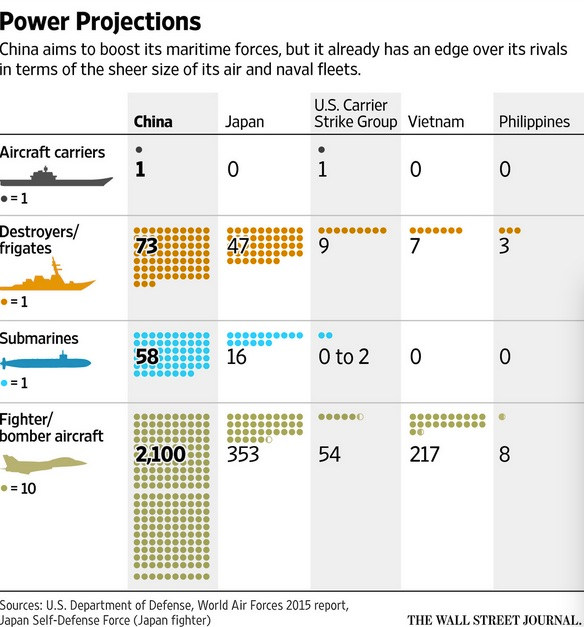
Indeed, The Wall Street Journal has shown that in terms of conventional warfare China is the undisputed heavyweight in the region with a massive airforce and navy – see infographic.
The Chinese are utterly scathing of U.S. “meddling” in the South China Sea, thousands of miles from its own borders and clearly views itself as the new hegemon in the region. This seemingly innocuous dispute has the potential to rapidly spiral out of control.
There are also simmering tensions between China and Japan.
Both have long held claims to the Japanese-administered islands — known as Diaoyu in China and Senkaku in Japan. Tensions have intensified in recent months, and observers fear that a political or military misstep could rapidly escalate.
In late 2013, China announced an air defense zone over the East China Sea, encompassing the disputed islands. The new policy would require airlines to give Chinese authorities their flight plans before entering the airspace designated by China.
Japan’s Prime Minister Shinzo Abe said the new policy “escalates the situation and could lead to an unexpected occurrence of accidents in the airspace.” The United States called China’s announcement “unnecessarily inflammatory.”
Military posturing is quietly reaching new extremes in Europe, the Mediterranean and the South China Sea and the provocative bluster is reaching new heights.
Separately, it is believed that a senior NATO official has warned that “we’ll probably be at war this summer.”

Tuesday, May 26, 2015

India Heatwave Proof of Global Warming or Apocalyptic End of the World?

image: http://guardianlv.com/wp-content/uploads/2015/05/Sun-650x488.jpg
India

The recent heatwave in India has so far killed at least 600 people, and as the heat does not seem to be easing up any, authorities are expecting that number to rise. Many are using the India heatwave as just another example of proof for theories like global warming or the apocalypse (end of the world). Though the rise in heat could be a cause of many different things, it is clear that it is not normal, and as it continues to cause heat stroke in hundreds of India’s residents, many across the globe are growing extremely concerned.
Of course by now, with so much hype going on about it over the years, nearly everyone is aware of the theories of global warming. The greenhouse gases that are released into the
image: http://guardianlv.com/wp-content/uploads/2015/05/global-warming-450x270.jpg
IndiaEarth’s atmosphere supposedly reduce the Ozone layer that protects the Earth from the sun and over time the world gets hotter, the weather gets crazier, and the climate changes. Theories about global warming show belief that the world will start experiencing stronger, more frequent storms and hotter weather in most places. Some of this theory does not necessarily make sense to some, but with the problems seen in the world recently, scientists certainly have examples that they can use as proof.

The heat in India reached 118 degrees Fahrenheit. Residents were warned to stay inside and drink much fluid. However, regardless of warnings and precautions, many across cities in India still perished from heat stroke. The deaths come in groups, leading to hundreds as a collective, in states such as Telangana, Andhra Pradesh and others. In combination with the violent tornadoes, massive flooding, dying off of birds from supposed avian cholera, and other climate and environmental events going on many believe that the heatwave in India is just another example that global warming is severely affecting the planet. However, others believe that global warming has nothing to do with it.
Preachers and religious enthusiasts are calling India’s heatwave just another example of an apocalyptic doom. Those who are religious do not believe that the heatwave in India is proof of global warming but rather the end of the world as told in the Bible, labeled the apocalypse. However, in this light the heatwave that has killed hundreds of residents in India is hardly the biggest event that has happened. In fact, many events have taken place that religious enthusiasts say are events on a timeline that leads to the end of the world, and India’s hot weather is just another example.
image: http://guardianlv.com/wp-content/uploads/2015/05/apocalypse2-450x428.jpg
IndiaRecently, many events have taken place that have put the fear in many who claim that the end of the world is near. Since 2012, people have been claiming to hear noises coming from the sky, which sound like trumpets or horns. NASA recently brought this to the attention of nearly everyone, as they worked to explain the noises, after two years of supposed occurrence. Then their were the birds that fell from the sky, which people believed was a sign from God. Scientists stated that the 2000 birds that rained down on Earth all had something call avian cholera, a disease which killed the massive amount of snow geese during their migration. It then also killed bald eagles who fed on the carcasses and later died. The wars in the Middle East also sparked some conspiracy, claiming that the wars resemble the Bible’s telling of the destruction of Damascus. Now with the crazy weather following, as
image: http://guardianlv.com/wp-content/uploads/2015/05/flooding.jpg
Indiatornadoes ravage the South, including a recent one in Mexico which was the strongest one that the country has had, flooding wipes out parts of Texas, Oklahoma, and other regions, and the heat rises like in the India heatwave, the end of the world in apocalyptic doom rumors are spreading.

So does the heatwave in India prove global warming or an apocalyptic end of the world? Combined with all of the other strange things that are taking place in the world right now, it is easy to see where one would believe such. However, if none of the other things were going on in the world, people probably would not think too much of the heatwave in India, other than the fact that it is unfortunate that it caused so many deaths. Whether the heatwave in India proves global warming, the apocalypse, or nothing at all, just depends on what a person believes.
By Crystal Boulware
Sources:
BBC: Massive India heatwave ‘kills 500′
CNN: 2000 snow geese drop dead from the sky in Idaho
Aljazeera: Deadly tornado tear through Mexican city
Guardian LV: NASA Weighs in on Apocalyptic Sounds From Heaven Heard During Month of Pentecost and Shavuot

Read more at http://guardianlv.com/2015/05/india-heatwave-proof-of-global-warming-or-apocalyptic-end-of-the-world/#bfeZPlfA9ST6f13D.99